The American Muslim group Darul Islam (also known as the Dar-ul-Islam Movement or simply “the Dar”) was a significant and influential grassroots movement founded by African American converts to Sunni Islam in the early 1960s. Emerging from the social upheaval of the era, it sought to establish a self-governing urban community that lived according to Islamic law.
Here is a summary of key information about the group:
📜 Origins and Founding (1962)
Darul Islam was born out of a split within the Islamic Mission of America, also known as the State Street Mosque in Brooklyn. This mosque, founded in the 1920s by Sheikh Daoud Ahmed Faisal, was one of the first institutions to bring together Muslim immigrants and African American converts. Over time, tensions grew between these two groups, leading a faction of African American converts, led by Rijab Mahmud and Yahya Abdul Karim, to depart and establish their own community in the Brownsville section of Brooklyn in 1962. They called it Darul Islam, an Arabic term meaning “abode of Islam,” signaling their ambition to build a community fully rooted in Islamic principles .
🏛️ Structure, Beliefs, and Practices
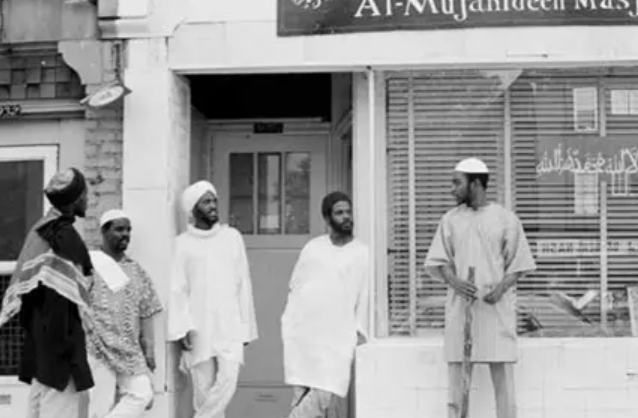
Darul Islam was notable for its disciplined and comprehensive approach to Islamic life.
- Ideological Influences: The movement was ideologically influenced by the writings of the Pakistani thinker Abu Ala al-Mawdudi. It emphasized a literal interpretation of the Qur’an and strict adherence to the Sunnah (the prophetic tradition), which for its members, fostered a degree of suspicion and separation from mainstream American social and political institutions.
- Organizational Structure: The movement was hierarchical, led by a governing body (majlis ash-shurah) and a central leader, Imam Yahya Abdul Karim. It was organized into various ministries for tasks like education, health, and defense. Notably, it had a paramilitary wing called the Ra’d (“thunder”), responsible for community protection and internal discipline.
- Community Life: Membership was formal, requiring a pledge of allegiance (bayat) and demonstrated knowledge of Islam. The community, especially at the Yasin Mosque in Bedford-Stuyvesant, built a vibrant, self-sufficient world with its own schools (like Madrassah Tush-Shaheedain), daycare, and even a scout group (Jawallah Scouts) . The movement was also very active in prison outreach, establishing mosques within New York state correctional facilities and influencing figures like Jamil al-Amin (formerly H. Rap Brown).
💥 Decline and Legacy
The unity of Darul Islam did not last. In the late 1970s, a charismatic Pakistani preacher named Sheik Syed Gilani gained a significant following that included Imam Yahya Abdul Karim. In 1980, Abdul Karim abdicated his leadership to follow Gilani, causing a major split within the movement.
- Offshoots: Gilani’s group became known as Jamaat al-Fuqra, a controversial organization that has been linked to violence and operates compounds in rural North America. Other mosques that remained loyal to the original Darul Islam ideology eventually reorganized under the leadership of Jamil al-Amin, becoming known as the National Ummah, or al-Ummah.
- Historical Significance: Despite its relatively short lifespan (1962-1983), Darul Islam left a lasting legacy as one of the first and most significant movements to establish an indigenous African American Sunni Muslim community governed by a strict interpretation of Islam. Its history is preserved in archival collections, such as the photographs of Khalil Abdulkhabir at the Brooklyn Public Library.
Of course. Following the decline of Darul Islam in the early 1980s, the movement split into two primary offshoots with very different trajectories: Jamaat al-Fuqra and the National Ummah (al-Ummah). Here is a more detailed look at both.
⚔️ Jamaat al-Fuqra: A Controversial Offshoot
Jamaat al-Fuqra, meaning “Community of the Impoverished,” was founded in 1980 by a Pakistani cleric, Sheikh Mubarak Ali Gilani. After Imam Yahya Abdul Karim abdicated his leadership of Darul Islam to follow Gilani, a significant faction joined this new organization. It’s important to note that while born from the same split, Jamaat al-Fuqra developed a distinctly different and more militant path.
- Ideology and Goals: The group’s ideology is described as a form of Islamist extremism focused on ‘purifying’ Islam through violence. It regards as enemies all those who do not follow its strict interpretation of Islam, including other Muslims it considers heretics. The group is separatist and has been described as a cult.
- Structure and Activities: Jamaat al-Fuqra is loosely structured, consisting of approximately 30 different communities or ‘Jamaats’ across North America. It has purchased isolated rural properties to establish communes, insulating members from Western culture. These compounds, such as Islamberg in New York, have been alleged to host paramilitary-style training. The group is known for its secrecy and use of front organizations like ‘Muslims of the Americas’ and ‘Quranic Open University’ .
- Violent History: The group has a significant history of violence, particularly in the 1980s and 1990s.
- 1983: Member Stephen Paster bombed a hotel in Portland, Oregon, owned by followers of the Rajneesh cult.
- 1980s: Members have been suspected or convicted in several assassinations and firebombings, including the murder of an Ahmadiyya leader in Michigan and a string of attacks on Hindu and Hare Krishna temples.
- 1991: Members plotted to bomb an Indian cinema and a Hindu temple in Toronto, Canada.
- 1993: Clement Rodney Hampton-El, a Fuqra member, was convicted for his role in the 1993 World Trade Center bombing.
Despite this history, Jamaat ul-Fuqra is not currently designated as a Foreign Terrorist Organization by the U.S. State Department, though it was included in a 1999 report on terrorist groups. Its founder, Sheikh Gilani, was arrested in Pakistan in 2002 in connection with the kidnapping of journalist Daniel Pearl.
🕌 The National Ummah (al-Ummah): Continuing the Legacy
The other major faction to emerge from Darul Islam was the National Ummah, commonly known as al-Ummah, which reorganized under the leadership of Jamil al-Amin .
- Jamil al-Amin (H. Rap Brown): Al-Amin’s journey is central to understanding al-Ummah. Born Hubert Brown, he was a prominent 1960s civil rights activist and Black Panther leader known as H. Rap Brown. While incarcerated in New York in 1971, he converted to Islam through Darul Islam’s prison outreach program. After his release, he went on hajj, moved to Atlanta, and eventually became the leader of the Darul Islam faction, which later evolved into al-Ummah.
- Community Work and Ideology: Under al-Amin’s leadership, al-Ummah focused on building strong, self-sufficient Muslim communities. In Atlanta, his followers were credited with revitalizing a neighborhood plagued by crime. However, the group’s ideology retained a revolutionary edge. Al-Ummah’s stated goal is to establish a separate, sovereign Islamic state within the U.S. borders, to be led by al-Amin. A criminal complaint has described the movement as a “nationwide radical fundamentalist Sunni group” .
- Later History and Controversy: Jamil al-Amin has been serving a life sentence since 2002 for the 2000 murder of a sheriff’s deputy in Atlanta. Despite his incarceration, al-Ummah mosques, such as the Community Masjid in Atlanta, and many others, still considered him their leader. He died in Prison on November 23, 2025. May Allah have mercy on his soul, and elevate him amongst the muqarrabeen wal ab’raar in paradise. Ameen
- In 2009, Luqman Abdullah, the imam of a Detroit mosque associated with al-Ummah (Masjid al-Haqq), was killed in an FBI shootout. The FBI had been investigating him for his radical ideology and rhetoric, which included praising groups like the Taliban and Hezbollah and encouraging violence against law enforcement. His death sparked controversy and calls for investigation from Muslim and civil rights groups, though official inquiries concluded the shooting was justified.
Imam Abu Laith Luqman Ahmad
imamabulaith@yahoo.com


Leave a Reply