بِسْمِ اللَّهِ الرَّحْمٰنِ الرَّحِيمِ، وَالصَّلَاةُ وَالسَّلَامُ عَلَى رَسُولِ اللَّهِ صَلَّى اللَّهُ عَلَيْهِ وَسَلَّمَ، وَبَعْد
For more than three decades, Saudi religious institutions played a central role in shaping the Salafi movement in the United States. Their books, tapes, translations, and fatwas flowed into Black American communities at a time when many new Muslims were searching for structure, certainty, and a sense of belonging. For a generation of Black converts, Saudi shaykhs were the ultimate authorities — distant, revered, and unquestionable. Their endorsements could elevate an imam; their criticisms could destroy a community. But over the last fifteen years, that relationship has quietly unraveled. Saudi Arabia has shifted its religious priorities, restructured its daʿwah institutions, and largely abandoned the American Salafi networks it once cultivated. And with that withdrawal, Black American Salafis have been left without the external anchor that once defined their religious identity.
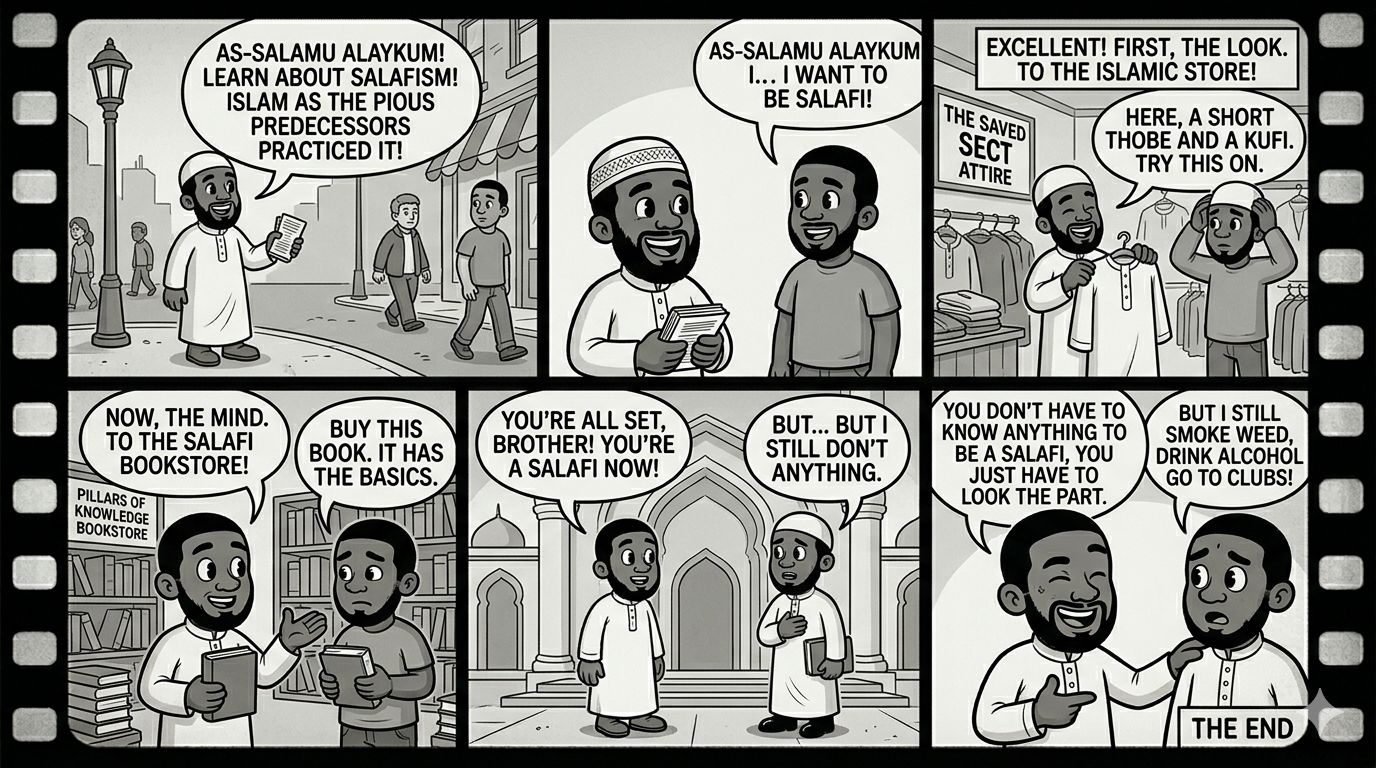
Yet even as the global Salafi pipeline has dried up, a small circle of Salafi imams and personalities in the United States continue trying to hold onto their influence. Their primary tool is the Salafi conference circuit — a rotating series of events where the same speakers deliver the same warnings about “deviant Muslims.” In Salafi vocabulary, a “deviant Muslim” is simply anyone who is not Salafi: Sufis, Ashʿaris, Māturīdīs, madhhab‑followers, Shiʿa, and even other Salafis who differ slightly in methodology. These conferences function less as spaces for spiritual nourishment and more as ideological maintenance sessions. They reinforce group identity by defining who must be excluded, who must be avoided, and who must be condemned. The message is predictable: the world is full of misguided Muslims, and only the Salafi manhaj is safe.
This strategy reflects a movement struggling to survive. Without Saudi backing, without institutional depth, and without the broad appeal it once enjoyed, American Salafism has shrunk into pockets of insularity. The conferences serve as a kind of life‑support system — a way to keep the remaining followers emotionally invested and ideologically loyal. They offer a sense of belonging, but only by drawing hard lines between “us” and “them.” They offer certainty, but only by narrowing the definition of Islam to a single interpretation. And they offer community, but only by isolating their followers from the broader Muslim world.
Meanwhile, the wider Black American Muslim community has moved on. Many have embraced traditional Sunni scholarship, reconnected with madhhabs, or simply grown weary of the constant denunciations and divisions of the Salafis. Others have recognized that the Salafi model, built on foreign authority, imported ideology, and rigid exclusivism, was never designed to empower Black Muslims or strengthen Black Muslim institutions. It was designed to create dependency, not independence; conformity, not creativity; fragmentation, not unity.
What remains today is a small but vocal remnant trying to preserve a model that no longer has the global infrastructure that once sustained it. Their conferences are louder, their warnings more dramatic, and their denunciations more frequent — not because the movement is strong, but because it is fading. And as the broader community continues to grow, evolve, and reclaim its own intellectual heritage, the last holdouts of American Salafism find themselves speaking to a shrinking audience, trying to keep alive a project that the very scholars who inspired it have long since abandoned.
The story of Salafism in Black American Muslim life is an ongoing story of intensity without longevity, certainty without depth, and zeal without stability. It is a movement that burned brightly but briefly, sustained not by its own strength but by foreign infrastructure that no longer exists. Many Salafi Imams have jumped ship
What is emerging now is something far more durable: a return to the Sunni tradition that has sustained the ummah for more than a millennium. A tradition that builds people, families, and institutions. A tradition that embraces complexity, honors scholarship, and connects Black Muslims to the global community of believers.
The seven‑year cycles are ending. The last holdouts are fading. What comes next in sha Allah is a renaissance, a return to roots, a return to balance, and a return to the Islam that builds civilizations.
Imam Luqman Ahmad
Shaykh Luqman Ahmad, born and raised in Philadelphia Pa, and son of American converts to Islam, is an American Muslim scholar, educator, and community leader with more than four decades of service. A graduate of the Islamic University of Omdurman, with time spent at Umm al-Qura University, and in classes at the Haram in Mecca. Imam was first introduced to Islamic learning by his parents, he studied with numerous scholars, most notably the late “Sayyid Sabiq”, author of the book “Fiqh as-Sunnah”. For a list of his teachers, consult his blog at imamluqman.wordpress,com. He served as the Imam of Masjid Ibrahim Islamic Center in California for 20 years, guiding one of the region’s most diverse Muslim communities with a blend of classical Sunni scholarship and deep awareness of American social realities. Over the course of his career, he has also served as an Imam and or resident scholar at several masaajid across the country, including in Philadelphia, Toledo, Sacramento, and Folsom, California.
He is the author of several books, most notably The Devil’s Deception of the Modern-Day Salafi Sect, a widely discussed critique of contemporary Salafism, and Double Edged Slavery, an original work examining the mentality, history, and lived experience of Black Sunni Muslims in America. His writings, lectures, and community work continue to influence conversations on Islamic law, identity, leadership, and the future of American Muslim communities. Currently, he writes, conducts research, and serves as a guest khateeb at the Quba Institute in Philadelphia. He can be reached at: imamabulaith@yahoo.com


Leave a comment