
بِسْمِ اللَّهِ الرَّحْمٰنِ الرَّحِيمِ، وَالصَّلَاةُ وَالسَّلَامُ عَلَى رَسُولِ اللَّهِ صَلَّى اللَّهُ عَلَيْهِ وَسَلَّمَ، وَبَعْد
Dear Respected Imams, leaders, and organizers of the upcoming African American “From Faith to Power” summit,
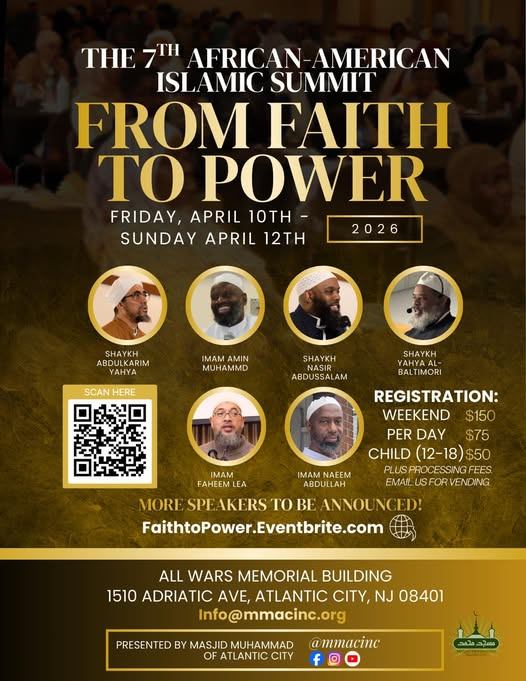
Assalaamu alaikum wa rahmatallahi wa barakaatuh. This letter is meant as naseeha to imams of this conference, focusing on the vital role of Black American Muslim communities, based on the hadith, “Religion is advice (naseeha)” and when they asked him to whom, he replied, “to Allah, to His Book, to His Prophet, to the Imams of the Muslims, and to general Muslims”. As you prepare to convene and deliberate on manifesting the weight of our faith into tangible power and influence, we offer this naseeha—a sincere counsel from the heart, for your consideration, on a matter fundamental to our collective future: the establishment of comprehensive, unified governance for Black American Muslim communities.
For centuries, Islam has taken root and flourished in this soil, with our communities serving as its bedrock. We have built masjids, schools, and organizations that stand as monuments to our faith. Yet, a critical pillar remains unfinished: a cohesive system of Islamic governance that transcends individual masjids to address the full spectrum of our communal life.
The very purpose of your summit—to move from faith to power—demands that we confront this gap with urgency and unity.
The Gap Between Our Faith and Our Function
Our power is fragmented here in the United States. While we thrive in our individual spaces, we operate in isolation on matters that define a community’s integrity and justice:
- Marriage and Divorce (Nikaah & Talaq): Processes vary wildly, lacking standardized, justice-oriented procedures that protect all parties and provide clarity under both Islamic and American law.
- Inheritance (Mirath): The detailed divine laws of inheritance are often unaddressed or applied inconsistently, leaving families vulnerable to confusion, conflict, and the unintended disinheritance of rightful heirs.
- Child Custody and Conflict Resolution: Disputes are resolved ad hoc, with no overarching framework to ensure fair, compassionate, and Islamically-grounded outcomes. The absence of formal networks means grievances often linger, eroding trust.
This is not merely an administrative shortfall; it is a spiritual and communal vulnerability that undermines the very justice (‘adl) our faith commands.
From Individual Efforts to Institutional Strength
The “Faith to Power” journey necessitates institutional maturity. Our long history here is not just a testament to survival but a divine mandate to build systems that reflect the comprehensiveness of Islam. This summit presents an unparalleled opportunity in sha Allah to initiate this work.
We must build governance structures that provide:
- Clarity and Consistency: Unified standards for marital contracts, divorce proceedings, and inheritance distribution, adapted wisely to our context.
- Justice and Redress: Formal alliances that establish credible conflict resolution bodies and grievance mechanisms, fostering accountability and trust across communities.
- Collective Influence: A unified front that strengthens our ability to advocate for our interests within the broader societal and legal landscape.
A Call for Unified Leadership
Dear Imams, you are among those who are uniquely positioned in sha Allah to lead or at least set the groundwork, with the help of others, for this transformation. Your knowledge of the Deen and your deep, lived experience within our communities. and your sincerity to the people, equip you to craft models that are both authentically Islamic and pragmatically American. Some of you I know personally, and I am a witness to your years of dedication to our cause of establishing Islam among our people.
We must, my dear Imams, change the existing narrative. This summit is the perfect venue to begin this serious, sustained conversation. Let us move beyond our individual masjid boundaries to envision a council or federation—a unified body that can serve all Black American Muslims.
This endeavor requires:
- Collaboration (Ta’awun): A commitment to work together for righteousness and piety.
- Trust (Thiqa): Building confidence in a shared vision for our future.
- A Shared Commitment to Justice (‘Adl): Placing the preservation of Islamic principles and the well-being of our communities above all.
Forging Our Future as Black American Muslims
Comprehensive governance of Muslim affairs across communities will not happen overnight. The transition from faith to power is fulfilled not just through political engagement, but through the establishment of just governance that nurtures and protects our own. By coming together at this summit you have the opportunity to begin the conversation and perhaps lay the groundwork for establishing a comprehensive system. You can ensure that the most personal and critical aspects of our lives—marriage, family, inheritance, and justice—are handled with the care, consistency, and integrity they deserve.
Our faith has existed here for generations, and our communities deserve nothing less. This is only my sincere naseeha to you as Imams, and as my brethren in faith. May Allah sub’haanahu wa ta’ala guide your deliberations, bless your summit, and unite your hearts upon this critical work. May He grant you success in building a legacy of unified, divinely inspired governance that will uplift and protect our communities for this generation and generations to come. Sincerely, and respectfully yours, wallahul Musta’aan, Imam Luqman Ahmad 4-6-26
Shaykh Luqman Ahmad, born and raised in Philadelphia Pa, and son of American converts to Islam, is an American Muslim thinker, scholar, educator, and community leader with more than four decades of service. A graduate of the Islamic University of Omdurman, with time spent at Umm al-Qura University, and in classes at the Haram in Mecca. Imam was first introduced to Islamic learning by his parents. He studied with numerous scholars, most notably the late “Sayyid Sabiq”, author of the book “Fiqh as-Sunnah”. For a list of his teachers, consult his blog at imamluqman.wordpress,com. He served as the Imam of Masjid Ibrahim Islamic Center in California for 20 years, guiding one of the region’s most diverse Muslim communities with a blend of classical Sunni scholarship and deep awareness of American social realities. Over the course of his career, he has also served as an Imam and or resident scholar at several masaajid across the country, including in Philadelphia, Toledo, Sacramento, and Folsom, California.
He is the author of several books, most notably The Devil’s Deception of the Modern-Day Salafi Sect, a widely discussed critique of contemporary Salafism, and Double Edged Slavery, an original work examining the mentality, history, and lived experience of Black Sunni Muslims in America. His writings, lectures, and community work continue to influence conversations on Islamic law, identity, leadership, and the future of American Muslim communities. Currently, he writes, conducts research, and serves as a guest khateeb at the Quba Institute in Philadelphia. He can be reached at: imamabulaith@yahoo.com


 Imam Luqman Ahmad Mosque Without Borders
Leave a reply to Imam Abu Laith Luqman Ahmad Cancel reply