
بِسْمِ اللَّهِ الرَّحْمٰنِ الرَّحِيمِ، وَالصَّلَاةُ وَالسَّلَامُ عَلَى رَسُولِ اللَّهِ صَلَّى اللَّهُ عَلَيْهِ وَسَلَّمَ، وَبَعْد
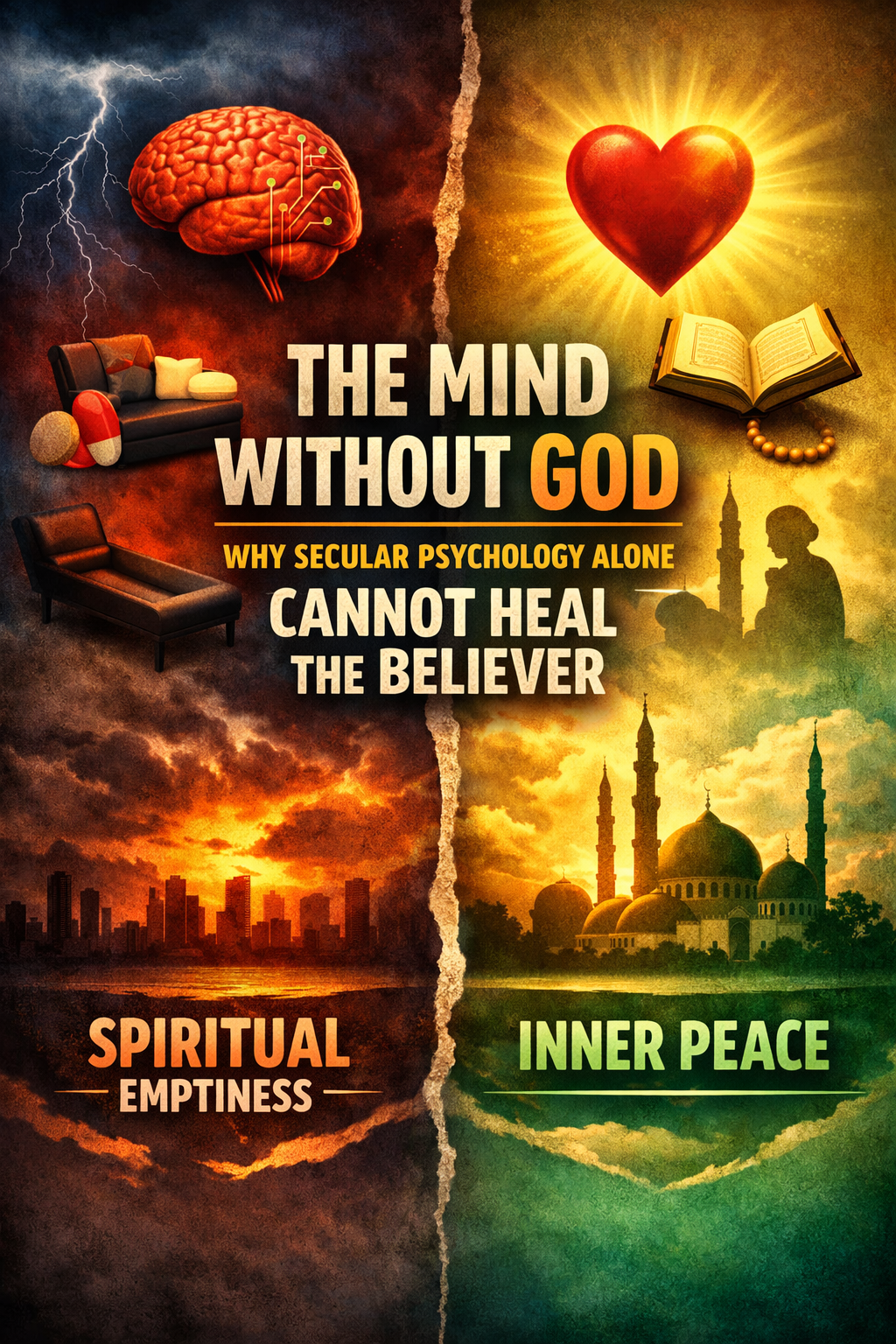
In a time when the language of trauma, emotional pain, healing, mental abuse, and mental health has reached a fever pitch in Black Muslim America’s conversation with itself, an unmistakable trend has emerged: many Muslims now turn first—and often exclusively—to modern psychology and its practitioners for relief. For a growing number, the therapist’s office has become the primary, if not the only, framework through which they interpret their inner struggles.
But this uncritical dependence has come at a cost. In the rush to seek help, many have unknowingly embraced a new belief system—one that functions less like a science and more like a secular religion: modern psychology. And it is here, at this crossroads, that the Muslim mind becomes vulnerable. When the tools of therapy replace the tools of revelation, when diagnostic labels overshadow spiritual vocabulary, and when the self is explored without reference to the Creator who fashioned it, the result is not healing but disorientation.
This article, The Mind Without God, examines how this shift occurred, why it is spiritually dangerous, and what it means for a community whose greatest strength has always been its God‑centered understanding of the human soul.
Modern psychology has contributed significantly to our understanding of human behavior, emotion, and cognition. It has mapped neural pathways, explored trauma, and developed therapeutic tools that genuinely help people navigate life’s difficulties. I recognize and appreciate these contributions. I have no interest in dismissing the entire discipline, nor do I deny that many Muslims have benefited from counseling, cognitive‑behavioral techniques, trauma‑informed care, and emotional literacy. These are real tools with real value.
But my caution—my bias, if you will—toward modern psychology arises from something deeper: its foundational worldview is secular, materialistic, and in many cases explicitly atheistic. This is not a side issue. It is the soil from which the discipline grew.
Sigmund Freud (1856–1939), the father of psychoanalysis, openly rejected belief in God. He described religion as an illusion, a projection of childhood helplessness, and a collective neurosis. His successors—Jung, Adler, Skinner, Watson, and others—built their theories on frameworks that either minimized or completely denied the spiritual dimension of the human being. Modern psychology, as an academic discipline, was constructed on the assumption that the soul does not exist, that revelation is irrelevant, and that human purpose is self‑defined rather than divinely ordained.
This is where my discomfort begins.
Many Muslims today, often with sincere intentions, direct those struggling with emotional or mental distress straight to modern psychoanalysis or secular therapy, bypassing the rich, time‑tested system of mental and spiritual wellness embedded in Islam itself. This reflects a subtle internalization of Western paradigms that separate the soul from the psyche, as if faith were irrelevant to healing. Yet the Qur’an and Sunnah offer a comprehensive framework for emotional regulation, resilience, and self‑reform—through dhikr, tawbah, sabr, shukr, and the cultivation of taqwa. Classical scholars like Abū Ḥāmid al‑Ghazālī (1058–1111 CE) and Ibn al‑Qayyim al‑Jawziyyah (1292–1350 CE) treated the heart as the center of cognition and emotion, prescribing spiritual disciplines that restore balance between body, mind, and soul.
When Muslims bypass these divine prescriptions and rush toward secular models, they risk treating symptoms while ignoring the root—spiritual disconnection. True healing begins not in the therapist’s chair, but in the remembrance of Allah, where the heart finds rest and the self regains its moral and spiritual coherence.
A psychology that excludes Allah reduces the human being to a biological machine—an organism driven by neural circuits, conditioned responses, and evolutionary impulses. It can describe behavior, but it cannot explain purpose. It can measure symptoms, but it cannot define wellness. It can analyze trauma, but it cannot speak to the meaning of suffering. It can observe the mind, but it cannot acknowledge the soul.
The Qur’an presents a radically different anthropology. The human being is not merely matter; he is a sacred trust. Allah says, “He fashioned him and breathed into him of His spirit” (32:9). This divine breath is not symbolic—it is the foundation of human identity. It means that the human being is a spiritual‑moral creature before he is a psychological one. Any system that denies this reality will inevitably misdiagnose the human condition.
This is why secular psychology, for all its utility, cannot offer a complete picture of human flourishing. It can tell you how anxiety manifests, how habits form, how trauma affects memory. But it cannot answer the questions that matter most:
What is a good life?
What is a healthy soul?
What is moral excellence?
What is the purpose of hardship?
What is the ultimate goal of human development?
Islam answers these questions with clarity. Taqwa is the highest form of psychological health. Sabr is resilience. Tawakkul is secure attachment to the Creator. Dhikr is emotional regulation. Tawbah is deep psychological repair. Ihsan is the peak of human flourishing. These are not poetic interpretations—they are the architecture of an Allah‑centered psychology.
A psychology without Allah cannot diagnose the diseases of the heart that the Qur’an identifies with precision: arrogance, envy, heedlessness, spiritual blindness, hardness of the heart, love of dunya, fear of death, despair of Allah’s mercy. These are not disorders in the DSM, but they destroy individuals, families, and civilizations. A psychology that denies the soul cannot heal the soul.
Our classical scholars understood this long before modern psychology existed. Al‑Kindi (c. 801–873 CE), Ibn al‑Qayyim (1292–1350 CE), al‑Rāghib al‑Aṣfahānī (d. early 11th century CE), Abū Zayd al‑Balkhī (850–934 CE), and Ibn Sīnā (980–1037 CE)—they were all, in their own way, psychologists of the soul. They studied the interplay of body, mind, and spirit. They analyzed the moral dimension of behavior. They wrote about the transformative power of worship, the psychology of sin and repentance, the role of community, and the cultivation of virtue. Their psychology was holistic, moral, spiritual, and God‑centered. Modern psychology, by contrast, is fragmented, value‑neutral, and materialistic.
When Allah is removed from the picture, psychology becomes a psychology without accountability. If there is no Creator, then there is no sin, no repentance, no moral responsibility, no ultimate justice, no afterlife, no purpose beyond self‑gratification. This produces a psychology of self‑worship, victimhood, moral relativism, identity confusion, nihilism, and spiritual emptiness. It is no coincidence that Western societies—despite having the most advanced psychological institutions in history—are drowning in anxiety, depression, addiction, and loneliness.
So yes, I recognize the benefit of modern psychology. I acknowledge its tools, its insights, and its therapeutic value. But I cannot accept a psychology that amputates the human being from his Creator. I cannot embrace a model that denies the soul, ignores revelation, and treats morality as subjective. My bias is not against therapy—it is against a worldview that excludes Allah and expects the human being to thrive without Him.
And this bias is reinforced by what I see among my own people—Black American Muslims, many of whom are struggling with trauma, emotional abuse, and stress. In our time, there is a growing tendency to elevate feelings above faith, to treat emotional pain as the ultimate truth rather than a call to spiritual realignment. Modern psychoanalysis often encourages this by centering the self instead of the soul, validating emotion without guiding it toward transcendence. While emotional awareness is important, it becomes dangerous when detached from divine guidance. Islam teaches that feelings are real but not sovereign; they must be disciplined by revelation, purified through worship, and healed through remembrance. When Muslims replace this divine system with secular therapy alone, they risk deepening their wounds rather than curing them.
For the Muslim, an Allah‑centered psychology is not optional. It is the only psychology that sees the human being as he truly is. It recognizes the fitrah as the baseline of mental health, worship as nourishment for the soul, sin as a psychological toxin, dhikr as a stabilizing force, shukr as cognitive reframing, tawbah as renewal, and the Qur’an as the ultimate healing. “In the remembrance of Allah do hearts find rest” (13:28). This is not metaphor. It is a psychological law.
Psychology without Allah is not neutral—it is harmful. It amputates the human being from his Creator, his purpose, his moral compass, his spiritual identity, and his eternal destiny. An Allah‑centered psychology restores the human being to his rightful place: a servant of Allah, striving for wholeness in this world and salvation in the next.
And Allah knows best.
Imam Abu Laith Luqman Ahmad
Shaykh Luqman Ahmad, born and raised in Philadelphia Pa, and son of American converts to Islam, is an American Muslim thinker, scholar, writer, educator, Imam, and community leader with more than four decades of service. A graduate of the Islamic University of Omdurman, with time spent at Umm al-Qura University, and in classes at the Haram in Mecca. Imam was first introduced to Islamic learning by his parents. He studied with numerous scholars, most notably the late “Sayyid Sabiq”, author of the book “Fiqh as-Sunnah”. For a list of his teachers, consult his blog at imamluqman.wordpress.com. He served as the Imam of Masjid Ibrahim Islamic Center in California for 20 years, guiding one of the region’s most diverse Muslim communities with a blend of classical Sunni scholarship and deep awareness of American social realities. Over the course of his career, he has also served as an Imam and or resident scholar at several masaajid across the country, including in Philadelphia, Toledo, Sacramento, and Folsom, California.
He is the author of several books, most notably The Devil’s Deception of the Modern-Day Salafi Sect, a widely discussed critique of contemporary Salafism, and Double Edged Slavery, an original work examining the mentality, history, and lived experience of Black Sunni Muslims in America. His writings, lectures, and community work continue to influence conversations on Islamic law, identity, leadership, and the future of American Muslim communities. Currently, he writes, conducts research, and serves as a guest khateeb at the Quba Institute in Philadelphia. He can be reached at: imamabulaith@yahoo.com


Leave a comment