
بِسْمِ اللَّهِ الرَّحْمٰنِ الرَّحِيمِ، وَالصَّلَاةُ وَالسَّلَامُ عَلَى رَسُولِ اللَّهِ صَلَّى اللَّهُ عَلَيْهِ وَسَلَّمَ، وَبَعْد
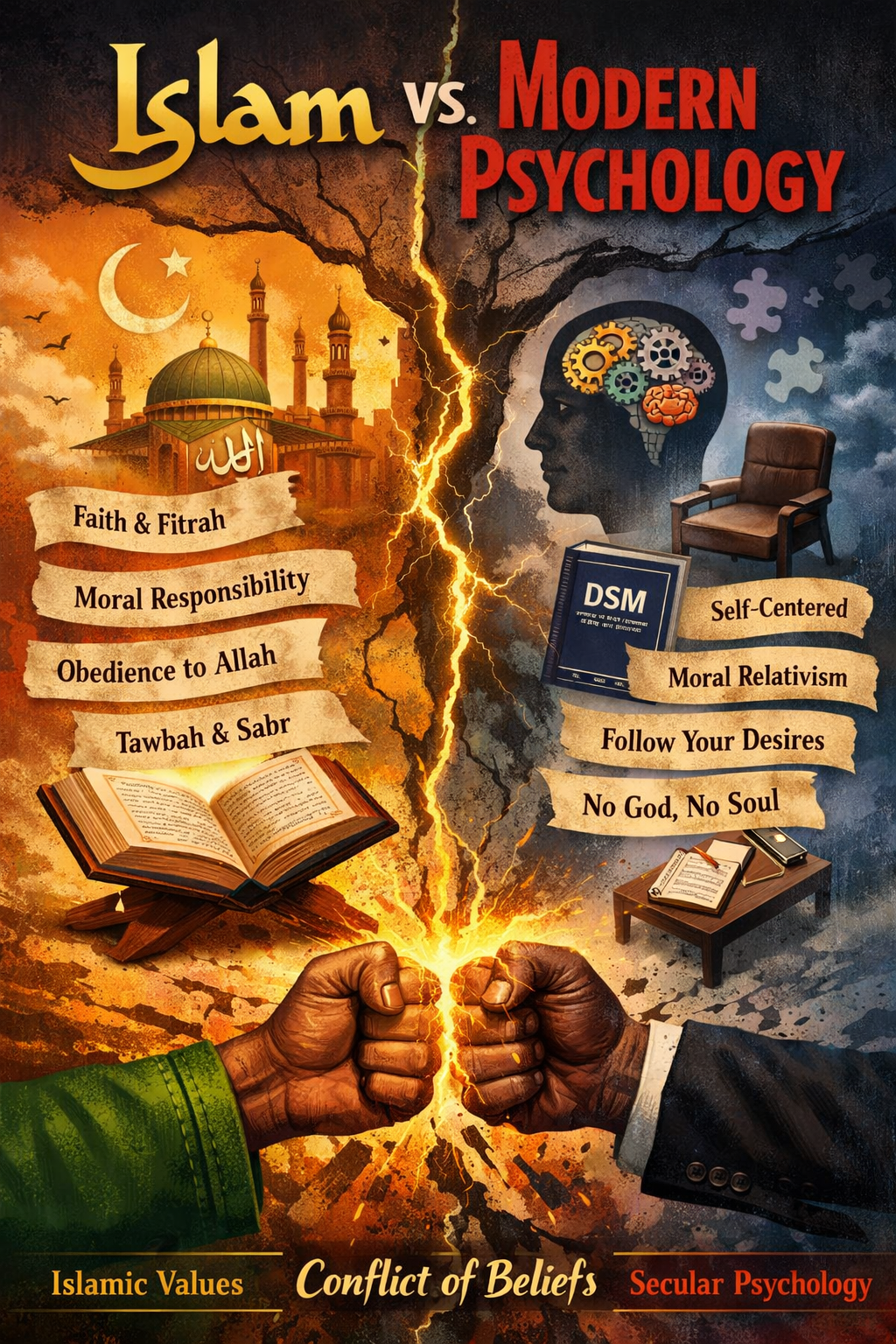
Modern psychology has become one of the most influential forces shaping how people interpret their emotions, their relationships, and even their sense of identity. It has seeped into schools, workplaces, social media, and everyday conversation. For many Muslims, it has quietly replaced the Qur’an and Sunnah as the primary framework for understanding the inner world. Yet beneath its therapeutic language and scientific posture, psychology rests on philosophical assumptions that often stand in direct contradiction to the foundations of Islamic belief.
At the heart of the conflict lies the fact that most modern psychological theories begin with a worldview that excludes the soul. Whether one looks at Freud’s psychoanalysis, Skinner’s behaviorism, or the humanistic models of Rogers and Maslow, the human being is treated as a purely material creature, an organism shaped by biology, environment, and personal experience. Revelation is irrelevant. The unseen world is dismissed. The ruh, the nafs, the qalb, and the fitrah are not even part of the conversation. Islam, however, begins with the soul. It teaches that the human being is more than neurons and impulses; he is a moral agent created with purpose, endowed with a spirit from Allah, and accountable for his choices. A psychology that denies the soul cannot heal the soul. It can only rearrange the furniture of the ego.
This foundational difference spills into the realm of morality. Secular psychology treats morality as subjective, culturally constructed, and individually defined. What is “right” is often reduced to whatever feels authentic or emotionally comfortable. The therapist’s role is not to guide a person toward moral truth but to help them live in alignment with their personal preferences. Islam, by contrast, grounds morality in divine revelation. Right and wrong are not determined by feelings, trends, or therapeutic consensus. They are fixed by the One who created the human being and knows what leads to flourishing. When psychology encourages people to “follow their truth,” it often means “follow your desires,” even when those desires contradict divine guidance.
This elevation of feelings to the highest authority is one of the defining features of modern therapeutic culture. Emotional validation becomes the ultimate good. Self-expression becomes sacred. Personal happiness becomes the measure of a healthy life. Islam does not demonize emotions, but it does not worship them either. The Qur’an teaches discipline, restraint, patience, and self-accountability. It teaches the believer to struggle against the lower self, not to sanctify it. Feelings are real, but they are not rulers. They are signals to be interpreted through revelation, not obeyed blindly.
Another point of tension emerges in how psychology interprets guilt, shame, remorse, and fear of consequences. In many therapeutic models, these emotions are treated as signs of dysfunction—problems to be eliminated. But in Islam, these emotions can be signs of a living heart. The Prophet ﷺ described the believer as one who feels pain when he sins. The Qur’an speaks of the self that blames itself as a stage of spiritual growth. When therapy reframes sin as trauma, conditioning, or a coping mechanism, it removes the possibility of repentance and moral transformation. It replaces tawbah with self-soothing.
The conflict deepens when we consider the sources of knowledge each system accepts. Secular psychology recognizes only empirical observation, experimentation, and human reasoning as valid. Revelation is excluded by definition. Islamic psychology, however, is built on the Qur’an, the Sunnah, and centuries of scholarship on the science of the heart. Thinkers like al‑Ghazali, Ibn al‑Qayyim, Ibn Sina, and al‑Razi developed rich models of human behavior, emotion, and spiritual development long before modern psychology existed. A system that rejects revelation cannot guide the believer to spiritual health; it can only offer coping strategies, not moral clarity.
This becomes especially clear in areas where psychology normalizes desires that Islam prohibits. Many modern frameworks encourage individuals to embrace impulses and identities that Islam teaches must be disciplined or restrained. The therapeutic goal becomes affirmation, not transformation. Islam, however, teaches that desires are to be purified, not indulged. Healing is not the same as surrendering to every impulse.
Another contradiction arises in how psychology views suffering. Many theories assume that life events are random, that suffering has no inherent meaning, and that humans have total control over their outcomes. Islam teaches the opposite. Every event unfolds with purpose, wisdom, and divine decree. Trials purify, elevate, and prepare the believer. Without qadar, suffering becomes meaningless. With qadar, suffering becomes a pathway to growth.
Even the structure of relationships is affected. Modern therapy often prioritizes radical individualism—personal autonomy, independence from family, and the pursuit of one’s own emotional comfort above all else. Islam prioritizes family ties, community cohesion, duty, and interdependence. The ummah is not built on individualism. It is built on connection, responsibility, and shared moral purpose.
Finally, the very definition of mental health differs between the two systems. Psychology often defines health as emotional comfort, the absence of distress, or the achievement of self-actualization. Islam defines health as tranquility of the heart, obedience to Allah, moral clarity, and spiritual discipline. A person can be emotionally comfortable yet spiritually bankrupt. And a person can be spiritually strong even while experiencing emotional difficulty.
When all of these contradictions are taken together, a deeper truth emerges: psychology, when stripped of God, becomes a competing religion. It offers a new vocabulary of the self, a new moral framework, a new explanation for suffering, a new path to “healing,” a new priesthood in the form of therapists, and a new scripture in the form of diagnostic manuals. For many Muslims, it has replaced tawbah with “processing,” sabr with “self-care,” dhikr with “mindfulness,” and jihad al‑nafs with “inner child work.” It has replaced reliance on Allah with reliance on emotional validation.
Islam does not reject beneficial knowledge from psychology. But it does reject any framework that contradicts revelation, undermines morality, or replaces the spiritual heart with the ego. A truly Islamic psychology must begin where the Qur’an begins—with the soul, with divine purpose, with moral accountability, with the purification of the heart, and with the remembrance of Allah. Anything less is incomplete. And Allah knows best. Imam Abu Laith Luqman Ahmad
Shaykh Luqman Ahmad, born and raised in Philadelphia Pa, and son of American converts to Islam, is an American Muslim thinker, scholar, writer, educator, and community leader with more than four decades of service. A graduate of the Islamic University of Omdurman, with time spent at Umm al-Qura University, and in classes at the Haram in Mecca. Imam was first introduced to Islamic learning by his parents. He studied with numerous scholars, most notably the late “Sayyid Sabiq”, author of the book “Fiqh as-Sunnah”. For a list of his teachers, consult his blog at imamluqman.wordpress.com. He served as the Imam of Masjid Ibrahim Islamic Center in California for 20 years, guiding one of the region’s most diverse Muslim communities with a blend of classical Sunni scholarship and deep awareness of American social realities. Over the course of his career, he has also served as an Imam and or resident scholar at several masaajid across the country, including in Philadelphia, Toledo, Sacramento, and Folsom, California.
He is the author of several books, most notably The Devil’s Deception of the Modern-Day Salafi Sect, a widely discussed critique of contemporary Salafism, and Double Edged Slavery, an original work examining the mentality, history, and lived experience of Black Sunni Muslims in America. His writings, lectures, and community work continue to influence conversations on Islamic law, identity, leadership, and the future of American Muslim communities. Currently, he writes, conducts research, and serves as a guest khateeb at the Quba Institute in Philadelphia. He can be reached at: imamabulaith@yahoo.com


Leave a Reply