
بسم الله الرحمن الرحيم و به نستعين
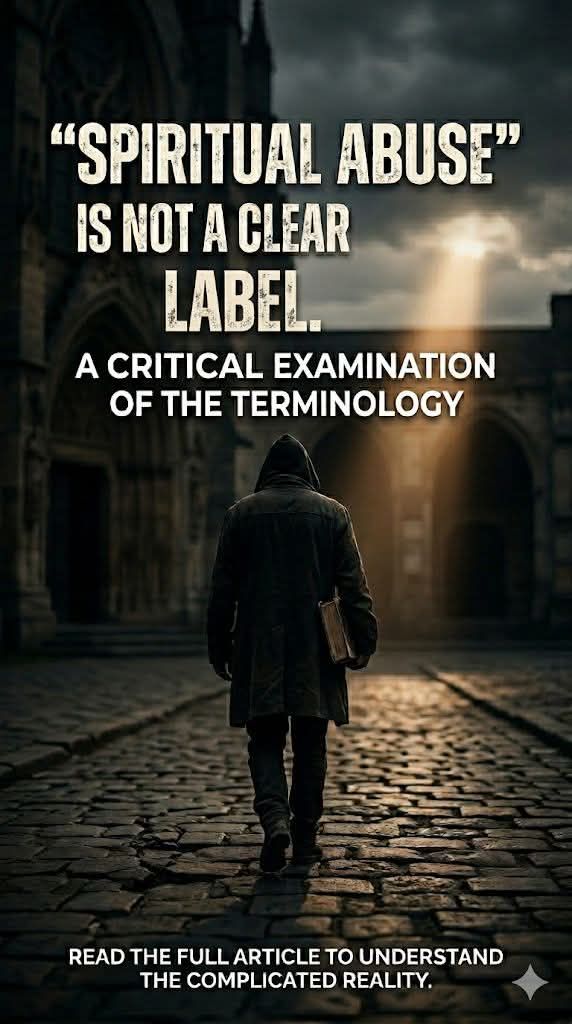
In recent years, a new phrase has quietly woven its way into the vocabulary of the Western Muslim community: “spiritual abuse.” Borrowed from modern psychology and Christian theological discourse, this quasi-psychological term is increasingly popularized to describe situations where religious authorities, such as Imams, community leaders, Islamic teachers, or even husbands utilizing religious justification—exploit their positions to manipulate, control, or mistreat others.
There is no denying the reality behind the complaints. Power dynamics are real, and human beings are entirely capable of using the veneer of religious authority to commit grave wrongs. However, as Muslims, we must look critically at the language we adopt to describe our trials.
While the harm being described is real, the coinage of “spiritual abuse” is fundamentally flawed. It is not an Islamic concept, and its theological implications inadvertently distort the reality of human accountability, the nature of the soul, and the absolute perfection of Allah.
1. The Soul Belongs to Allah: The Concept of the Ruh
To understand why the term is inappropriate, we must look at what the spirit actually is in Islam. The Ruh (spirit) is a divine trust, an entity belonging to the realm of the unseen and governed directly by Allah. ”And they ask you, [O Muhammad], concerning the Ruh. Say, ‘The Ruh is of the affair of my Lord. And mankind has not been given of knowledge except a little.’” (Surah Al-Isra, 17:85)
A human being can abuse your body, your finances, or your trust. They can slander your reputation. But they cannot “abuse” your soul. Your soul’s vertical relationship with its Creator is entirely sovereign; it cannot be damaged or corrupted by an external human force unless you permit it to be. Labeling a bad experience as “spiritual abuse” grants a corrupt human being far too much power, implying they have successfully reached into the unseen realm and fractured your divine connection.
2. Externalizing Blame and Shifting Accountability
One of the greatest dangers of adopting modern, victim-centric therapeutic language wholesale is that it risks eroding the core Islamic doctrine of personal accountability ( Taklif ).
In Islam, every individual is the gatekeeper of their own heart ( Qalb ). When a person is misled, manipulated, or driven to despair by a harsh teacher or an oppressive husband, we must look at two sides of the coin: the transgression of the wrongdoer, and how the recipient processes the information.
Two people can sit in front of the exact same overly severe religious teacher. One might recognize the harshness as a human flaw, filter it out through the lens of sound knowledge, and maintain a healthy relationship with Allah. Another might internalize that harshness, blame the religion, and fall into despair.
Islam teaches us that we are active agents, not passive victims, in our spiritual journeys. If we absorb flawed guidance or allow someone to dictate our spiritual self-worth, we have a duty to ask ourselves:
Did a lack of sound knowledge ( ‘Ilm ) leave us vulnerable to their manipulation?
Did we allow our hearts to blindly follow a human personality rather than the immutable truth of the Quran and Sunnah?
By labeling our spiritual struggles as an “abuse” inflicted upon us, we externalize the blame. We shift the focus entirely onto the perpetrator, making our spiritual survival dependent on how others treat us, rather than taking radical ownership of our own relationship with Allah.
3. Allah is Al-`Adl (The Just): The Divine Message is Intact
Perhaps the most serious theological hazard of the term “spiritual abuse” is that it subtly shifts blame toward the spiritual realm itself. If the spirituality is what is abused, it implies a defect or vulnerability in the divine system.
But Allah is entirely free from injustice ( Zulm ). His Deen is perfect, balanced, and a source of ultimate mercy.
”And your Lord does injustice to no one.” (Surah Al-Kahf, 18:49)
When a husband uses a verse of the Quran to bully his wife into submission, or an Imam uses his pulpit to insulate himself from criticism, the religion has not failed. The spirit has not been abused. Rather, a human being has committed a profane transgression. The fault lies entirely in human behavior, human ego, and human misinterpretation.
4. Reclaiming the Vocabulary of Islam
We do not need to borrow quasi-psychological terms from secular frameworks to address bad behavior in our communities. Islam already possesses a robust, exact vocabulary that calls out bad actors without compromising our theology.
When an Imam, teacher, or husband misuses his authority, Islam labels it precisely as
Zulm: (Injustice/Oppression): The perpetrator is committing Zulm against another person. They will face the consequences of this on the Day of Judgment. The focus remains on human tyranny, keeping the spiritual path pure.
Fitnah (A Trial of Faith): Encountering a corrupt or toxic religious figure is a profound test. It is a tribulation meant to test whether we worship Allah, or whether we worship the people who speak about Him.
Ghuluw (Extremism/Excess): When teachers make the religion unnecessarily rigid, driving people away, they are guilty of Ghuluw, a concept the Prophet ﷺ explicitly warned against.
Muslims can and should retire the borrowed un-islamic terminolgy (spiritualabuse), and replace it with terminolgy more in keeping with the architecture of Islam. An Islamic alternative to the term spiritual abuse would be the term zulm (oppression). This Keeps the blame entirely on the human perpetrator; leaves the soul’s sanctity intact.
Or instead of zulm you could classify so-called Spiritual Abuse as Fitnah (Spiritual Trial). This recontextualizes the pain as a test of faith that requires turning toward Allah, not away from Him.
The pain of being let down, manipulated, or mistreated by those who represent the religion is undeniably heavy. But the solution is not to adopt terms that strip us of our spiritual agency.
We must hold corrupt leaders and abusive husbands accountable by calling their actions what they are: Zulm (oppression) and a violation of the sacred law. But we must guard our own souls with fierce independence. No matter how badly a human being behaves, your Ruh belongs to Allah. By taking responsibility for how we receive, filter, and act upon religious information, we reclaim our power as servants of the Most High, unshakable by the flaws of the flawed people around us. And Allah knows best. Imam Abu Laith Luqman Ahmad
Shaykh Luqman Ahmad, born and raised in Philadelphia Pa, and son of American converts to Islam, is an American Muslim thinker, scholar, writer, educator, and community leader with more than four decades of service. A graduate of the Islamic University of Omdurman, with time spent at Umm al-Qura University, and in classes at the Haram in Mecca. Imam Luqman, was first introduced to Islamic learning by his parents. He studied with numerous scholars, most notably the late “Sayyid Sabiq”, author of the book “Fiqh as-Sunnah”. For a list of his teachers, consult his blog at imamluqman.wordpress.com. He served as the Imam of Masjid Ibrahim Islamic Center in California for 20 years, guiding one of the region’s most diverse Muslim communities with a blend of classical Sunni scholarship and deep awareness of American social realities. Over the course of his career, he has also served as an Imam and or resident scholar at several masaajid across the country, including in Philadelphia, Toledo, Sacramento, and Folsom, California


Leave a Reply